Horses, Haciendas, and Forbidden Parties:
The Rumor That Linked Emiliano Zapata to the Dance of the 41
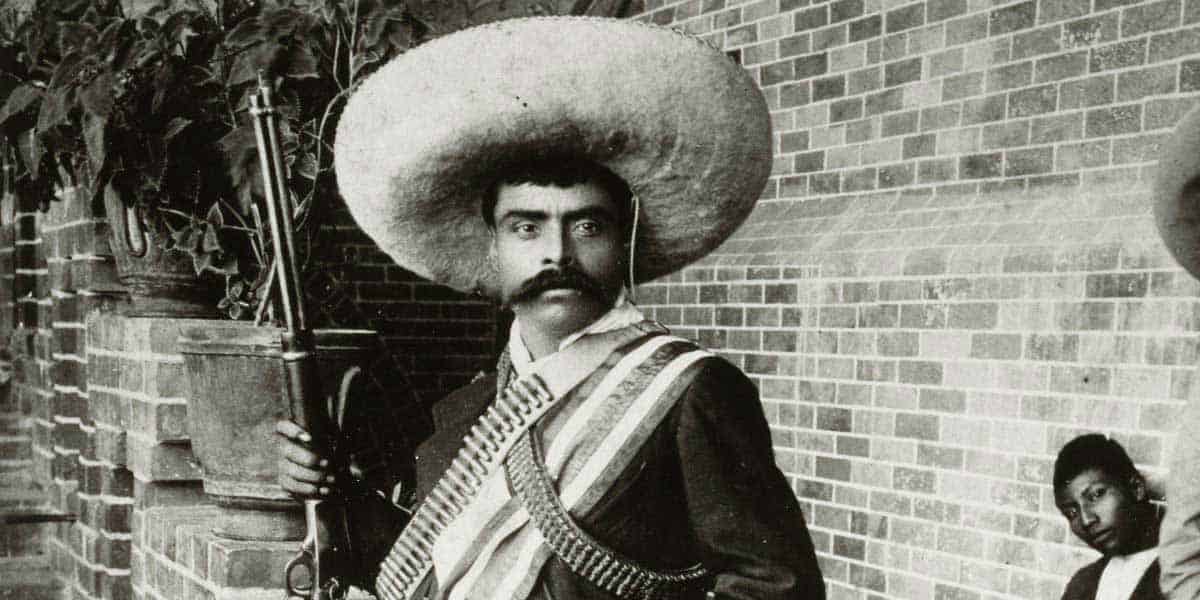
What does the most infamous man in Mexican history have in common with the biggest revolutionary figure of the country’s Civil War? Babe, grab your snacks, because this story has it all: love, sex, betrayal, gunpowder, and hot, steamy men.
Before we get into the juicy gossip, we need to know who’s who in this story. Our main characters are Porfirio Díaz’s infamous son-in-law, Ignacio de la Torre, and Emiliano Zapata, Mexico’s ultimate “poster boy,” who modeled what a Mexican macho should look like for future generations.
Emiliano Zapata: Not the Peasant You Were Taught About
Emiliano Zapata, born in 1879 in the state of Morelos, was a caballerango (essentially a head groom responsible for horses on local estates), known for defending the rights of the impoverished and underprivileged in México, especially before, during, and after the Civil War (1910–1917).
However, Zapata is more than the national hero the Mexican government has painted him out to be. His popularity over the years has become much more nuanced. He was known to be a “ladies’ man,” and there has long been discussion about where he lands on the sexual spectrum.
While specialists have been divided, with some saying he was either gay or straight, there’s really no way to know any of this with 100% certainty. Zapata officially had 16 children with nine different women, and there’s speculation that the number of children might be even higher than 20. At the same time, there are plenty of people whose ancestors fought alongside Zapata (some of them close friends or war buddies) and those who recall pictures of the revolutionary rebel being just a little bit too friendly with other men. Wink wink.
Enter the Porfirian Golden Boy
But how does all of this tie in with Ignacio?
Ignacio de la Torre, born in Mexico City in 1866, came from a lineage of hacendados (major hacienda owners), whose wealth was built on sugar plantations across the country. Known for being the bachelor of his time, he was married to Amada Díaz, the youngest daughter of the dictator Porfirio Díaz (yes, our very own version of Donald Trump).
This arranged marriage had its trials and tribulations, largely due to the enormous social pressure for men to be as manly as possible. Basically, Díaz asked Ignacio if he wanted to become the next president of México. Nachito (as he would be known for posterity) said yes, and Díaz replied,
“Cool! The only thing you have to do now is marry my daughter.”
And while this kind of arrangement wasn’t uncommon, love or desire was never part of the equation.
OK, But…
How the Hell Do These Two Even Connect?
First, a very important disclaimer.
The story you’re about to read cannot be fully verified. What follows is rumor and speculation mixed with historical facts. As it happens time and time again, the “official” version of history is often one-sided and carries a very clear agenda. So before we move on, it’s important to state this plainly: the alleged affair itself is not confirmed.
Yes, yes, I get it! But keep reading.
The Dance of the 41: Bacchus meets… Mexicans?
In 1901, Nachito participated in the infamous Dance of the 41, where police burst into a private elite party of Bacchanalian proportions. This raid turned Ignacio’s sexuality into a matter of public discussion and effectively crowned him México’s first historic fuck boy.
As a result of the scandal, Amada and Ignacio were forced to stay married, and Ignacio’s political ambitions came to an abrupt halt. He never became president. Other than that, he suffered very few consequences. Upset but untouchable, he continued his life with little regard for his wife.
Everything up until this point is documented history.
I promise I’ll dedicate an entire blog to this event soon!
Amada’s Diaries, the Missing Pages, and the Rumor That Wouldn’t Die
Amada Díaz documented much of her life with Ignacio in her diaries. These writings were later compiled into a book titled El álbum de Amada Díaz, which became the primary reference for many of the rumors surrounding this story.
In her writings, Amada moves from unconditional love for her husband to deep resentment, particularly over the fact that Ignacio never even granted her the ‘blessing’ of a child. As if that weren’t enough, she endured constant criticism for not knowing her husband was gay… give me a break!
According to popular rumor, Amada’s diaries reference Ignacio’s sexual ventures throughout their pages, including a supposed love affair with a stable boy. One widely repeated (but unverifiable) quote reads something along the lines of:
“I’m sick and tired of Ignacio fucking around with the stable boy like I don’t even exist.”
When speculation arose that Emiliano Zapata might have been the “stable boy” mentioned, Mexican authorities completely lost their shit.
What did happen next, however, is very telling.
The book was banned and destroyed by the government. Because of this, we cannot confirm whether this passage existed, how it was written, or who it referred to.
Why Zapata Is Even Part of This Story
Contrary to popular belief, Emiliano Zapata was not a poor peasant. He was known within elite circles as the horse whisperer of his time. If you were wealthy and wanted your horses properly trained, Zapata was your guy.
This work allowed him to live closely with elite families for months at a time. One of the last families he worked for was the Díaz–de la Torre household, whose mansion stood on what is now Reforma Avenue.
We know Zapata worked with them for only six months, and resigned in 1906, as he famously stated:
“It’s a shame to realize that the horses are better fed than the impoverished Indigenous people who work the lands.”
That quote speaks volumes, not only about his character, but about his spirit and later revolutionary involvement.
Why This Rumor Made Everyone Lose Their Shit
While we can’t confirm the affair itself, the government’s reaction to the possibility of Zapata having a relationship with a man, especially the dictator’s son-in-law, is deeply revealing. No one bans a book over a teeny-tiny rumor, unless…
Zapata was later transformed into the ultimate symbol of Mexican masculinity. A war hero. A defender of the underprivileged. Exceptionally good-looking stud. And father of many children.
What’s interesting is that while he was alive, he received very little recognition and was ultimately betrayed by his own “allies” before the Civil War ended, leading to his execution in 1916. The myth came later, and it was carefully, purposefully curated.
Labels Are New. Desire Isn’t.
This story teaches us a valuable lesson: sexuality doesn’t matter… until it does.
The narratives promoted by authorities, and repeated by society, show a clear bias, especially when it comes to bisexual and pansexual people throughout history. Terms like gay, lesbian, and bisexual are relatively recent as identity labels; their widespread use dates mostly to the 20th century.
When it comes to bisexual and pansexual people, there has been constant erasure. The modern obsession with neatly labeling everything forces people to “choose a side,” even when reality is much more complex.
We may never know whether Emiliano Zapata was queer. But the question itself opens a much broader conversation.
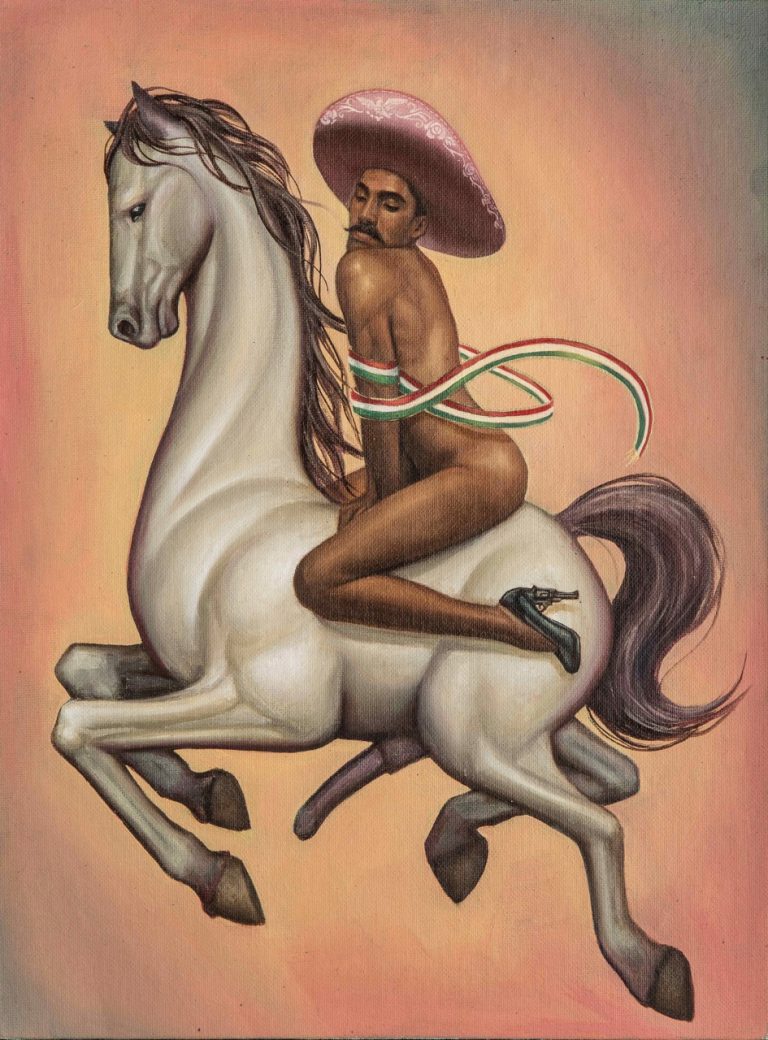
The Queerification of Zapata
Zapata has inspired artists for generations to explore these tensions. Paintings like La Revolución by Mexican artist Fabián Cháirez force audiences to confront the idea that sexuality is not black and white.
It’s a spectrum, it changes over time, and what feels true today may not be tomorrow.
And maybe that discomfort says more about us than it ever did about Emiliano Zapata.
Questioning what you know?
You’re in the right place!
If this story surprised you or challenged what you thought you knew about México, our walking tour goes even further.
Join MXCity for the Girls, Gays & They’s, where we walk through the living testament of the queer, feminist, and politically inconvenient histories that never made it into textbooks, but absolutely shaped our heritage.